
The Weakest Layer Is Human
Most breaches begin with a person, yet the human layer is the one companies manage with an annual training video. The human is not your weakest link.

This is Part 6, the final part of "The Corporate Security Gap", a series on why companies have security on paper but not as a function. Part 1: The Function That Never Got a Seat. Part 2: The Cost Center That Cannot Count. Part 3: Security Built in Silos. Part 4: The Door You Did Not Lock. Part 5: Plans Without Resilience.
The incident starts at 6.40 in the evening, with one tired person at the end of a long shift. An email that looks like a supplier reply, a sense of wanting to clear the inbox before leaving, a click. Everything downstream of that click worked exactly as designed: the firewall, the endpoint protection, the segmented network, the monitoring. None of it mattered.
Because the attack did not go through any of those. It went through the one part of the system that was never engineered to the same standard as the rest, and then walked, with valid credentials, past every control that assumed the person holding them was the person using them.
This is the sixth and final article in this series, and it is the one the previous five were always going to arrive at. Part 1 found security missing from the table where value is weighed against risk. Part 2 showed it could not count itself. Part 3 found it split into silos with open seams. Part 4 followed those seams out through suppliers’ doors. Part 5 showed that when the hit lands, a plan is not a capability. Set them side by side and a single point appears underneath all of them: each gap, traced far enough, ends at a person. The board seat is occupied by people. The thing that gets measured is people’s work. The silos are walls between teams of people. The supplier door is opened by someone’s trust. The continuity plan lives or dies on what people actually do in the first hour.
The human layer is not the sixth gap in a list of six. It is the surface the other five are drawn on, and it is, by a wide margin, the one companies manage least like a system. The human is not the bug. It is the layer.
The layer, not the link
Start with the phrase the whole field gets wrong. “Humans are the weakest link” sounds like rigour and is actually an evasion, because a link is a component you replace or route around, and you can do neither with your own workforce. The honest framing is architectural: the human layer is the set of people who operate the system, and like any layer it can be well-designed or badly-designed, but it cannot be removed. Around 60% of breaches involve a human element, according to Verizon’s 2025 Data Breach Investigations Report, whether through error, social engineering, or misuse. That is not a statistic about weak individuals. It is a statistic about where the system meets the world, and the system meets the world through people.
The framing matters because it forces a distinction the word “link” hides, and the distinction is the whole of the governance problem. Three different things get collapsed into “human error”. There is error, the genuine mistake by someone trying to do their job. There is negligence, the cut corner, the reused password, the ignored policy, which is cultural rather than individual. And there is malice, the insider who means harm. They demand opposite responses, and the proportions are not what fear assumes: in the Ponemon Institute’s 2025 study of insider risk, 55% of incidents traced to negligence and a further 20% to credential theft, leaving 25% genuinely malicious. Three quarters of the insider problem is not an enemy. It is the layer behaving the way an unmanaged layer behaves, and the same study put the average annual cost of all of it at 17.4 million dollars. You cannot fire your way out of a problem that is three-quarters not malicious. You have to design for it.
Why the layer stays unmanaged
Four mechanisms keep the largest attack surface the least engineered.
First, training is mistaken for culture. The standard response to human risk is the annual security-awareness module, completed, scored, certified, filed. It produces a record, not a behaviour, and the evidence on that point is now hard to wave away. A 2025 reproduction study by Rozema and Davis at Purdue University, run across 12,511 employees at a financial-technology firm, found that
anti-phishing training produced no statistically significant effect on click rates
(p=0.450) or on reporting rates (p=0.417), with effect sizes the authors call negligible. People who had completed the training clicked at essentially the same rate as those who had not. The certificate of completion attests that the module was watched. It does not attest that anyone is harder to phish. This is the series’ recurring shape in its final form: the formal artefact exists, the function it stands for does not. Security without governance is just guarding, and a training certificate without a change in behaviour is just paperwork.
Second, blame is mistaken for accountability. When the tired person clicks, the reflex is to find them, retrain them, perhaps discipline them. It feels like accountability and functions as concealment, because in a culture that punishes the click, the next person to click does not report it, and the organisation loses the one thing that would let it improve: knowledge of what is actually going wrong. A culture that blames individuals optimises for silence. A culture that examines systems optimises for disclosure, and disclosure is the raw material of every improvement that follows.
Third, the attacker has noticed that the layer is cheap to attack. Social engineering is not a fallback for adversaries who cannot break the technology; it is the rational first choice, because manipulating a person is faster and cheaper than defeating a firewall, and the DBIR’s social-engineering and phishing patterns sit at the top of the list for exactly that reason. A median user, the report notes, falls for a phishing email in under a minute. The defensive budget is spent overwhelmingly on the technical layers, while the attacker spends almost nothing and aims at the layer nobody engineered.
Fourth, fatigue and understaffing are treated as HR problems when they are security problems. A tired, overloaded, under-resourced workforce makes more mistakes, and mistakes are the bulk of the human-layer risk. A team running permanently hot, covering vacant roles, working through alert fatigue, is not merely an HR concern about wellbeing; it is a measurably larger attack surface. The exhausted analyst who waves through an anomaly at the end of a double shift is a security event waiting for its trigger. Treating burnout as a morale line item rather than a risk control is itself a governance failure, because it misfiles the cause of a large share of incidents.
The comparison the board never sees
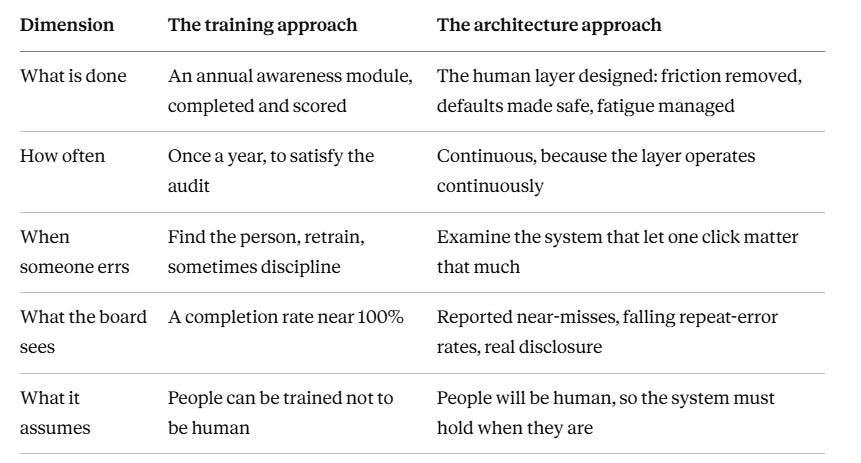
The right-hand column is not softer than the left. It is harder, because it refuses the comfortable fiction that the problem is the individual and accepts the expensive truth that the problem is the design.
What aviation already settled
There is an industry that resolved this decades ago, and the contrast is instructive precisely because the stakes there are measured in lives. Aviation, and after it much of medicine, moved from blaming the individual to engineering the human layer, under the banner of “just culture”. The principle, formalised by the psychologist James Reason, is not no-blame, which would be neither credible nor safe; it is a clear, consistent line between honest error, at-risk behaviour, and recklessness, with honest error met by system redesign rather than punishment. Around that principle sit confidential reporting systems that surface mistakes instead of hiding them, crew resource management that flattens the hierarchy so a junior officer will challenge a senior one, and fatigue-management rules treated as safety controls, not perks. The result is an industry where reporting an error is expected behaviour and the system is continuously reshaped around what gets reported. Corporate security, with rare exceptions, is still at the stage aviation abandoned: a poster, a module, and a search for someone to blame when the inevitable happens.
The line
Every article in this series has described the same disease from a different angle: a formal structure standing in for a real function. The seat that was a box on a chart, the budget that counted activity, the four walls with open seams, the contract that was not control, the certificate that was not a capability. The human layer is where the pattern reaches the surface it was always resting on, because a person occupies every one of those gaps. And it is the cleanest illustration of the whole series’ thesis, because here the substitute is so familiar it is invisible: a company that has trained its people believes it has secured them, exactly as the company with a seat believed it had governance and the company with a certificate believed it had resilience. Stop calling the human the bug.
The bug is the belief that a layer this large could ever be patched instead of designed.
So the question the series closes on is not how to patch this last gap, because it was never a list of gaps to patch. It is whether the company sees security as a system at all, a property of how the whole organisation is designed, owned, measured, and rehearsed, or as a set of departments and documents that each look complete in isolation while the seams between them, and the people across all of them, belong to no one. Security without governance is just guarding. The series began there, and it ends in the same place, one layer deeper: the guards are people, the function is a system, and no company that confuses the two is as secure as its certificates say it is. The gap was never only in security. It was in the way security was governed.